ශ්රී ලංකා තානාපති කාර්යාලය, වොෂින්ටන් ඩී.සී., ඇමරිකා එක්සත් ජනපදය
இலங்கைத் தூதரகம், வொஷிங்டன் டி.சி, ஐக்கிய அமெரிக்கா
Embassy of Sri Lanka, Washington D.C.,United States

Trade Relations between Sri Lanka and the U.S.
US – SRI LANKA ECONOMIC RELATIONS – (Trade, Investment & Tourism)
1. US-Sri Lanka Bilateral Trade Relations
The US-Sri Lanka economic partnership spans more than 100 years.
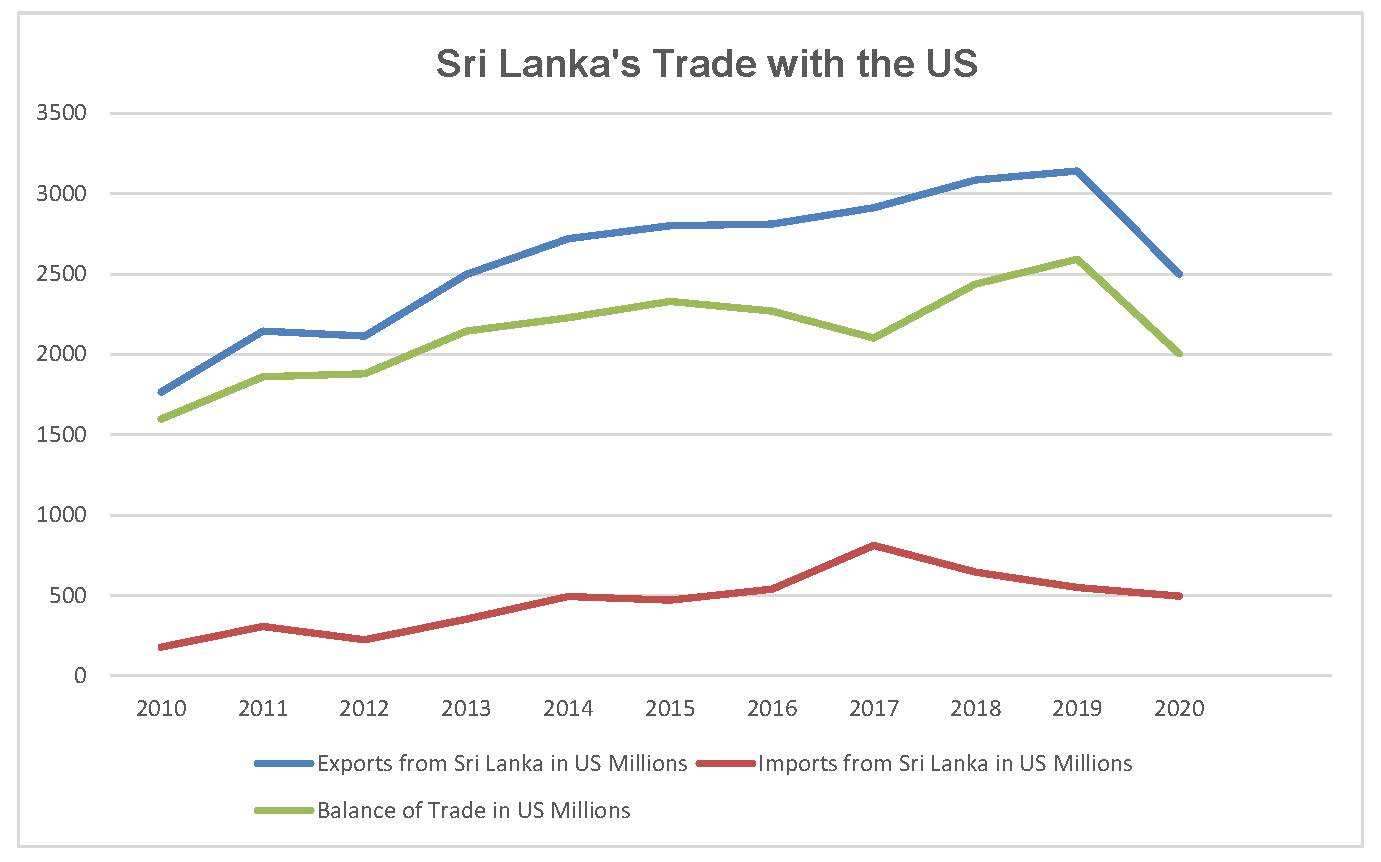
The United States continues to be the single largest export destination for Sri Lankan products, accounting for 23.02% of Sri Lanka’s total exports in 2025. Over the past ten years, Sri Lankan exports to the United States have fluctuated, reaching a peak of US$ 3,291 million in 2022. According to the latest trade statistics, Sri Lankan exports to the United States has amounted to US$ 2,999 million in 2025. During the same year, imports from the United States totaled US$ 732 million, bringing the total bilateral trade turnover to US$ 3,731 million. The balance of trade remained in favor of Sri Lanka, amounting to US$ 2,266 million in 2025.
2. Trade and Investment Framework Agreement (TIFA) between Sri Lanka and the USA
The Trade and Investment Framework Agreement (TIFA), signed by Sri Lanka and the United States on 25 July 2002, provides a framework for the two governments to maintain regular dialogue on areas of trade and investment.
The 14th U.S.-Sri Lanka Trade and Investment Framework Agreement (TIFA) Council Meeting was held in Sri Lanka on 18 September 2023. During this meeting, the two sides held productive discussions on improving market access, enhancing the investment climate, and addressing trade barriers. The discussions also covered labor law reforms, anti-corruption measures, and the promotion of transparency and good governance. Both countries agreed to strengthen collaboration in technology transfer, the digital economy, floriculture, boat building, and coconut research, and to expand agricultural trade by facilitating U.S. export access and reducing Sri Lankan trade barriers. They reaffirmed their commitment to transparency, efficient foreign investment, and stakeholder participation.
The pre-discussion for the 15th Joint Council Meeting was held on 21 March 2024. The 15th Joint Council Meeting will take place in the near future.
3. Bilateral Air Transport Agreement
The Bilateral Air Transport Agreement was signed on 11 June 2002 and entered into force on 18 November 2002. This Open Skies Agreement provides a legal framework for unrestricted capacity and frequencies for airlines of both countries, including liberalized code-sharing and charter arrangements. The agreement covers both passenger and cargo services and is expected to bring substantial economic benefits to air travellers, the business community, and Sri Lankan expatriates in the United States. It also provides for cooperation in air traffic security and safety between the two countries.
Sri Lanka’s trade with the US
| Year | from Sri Lanka(US$ million) | Imports into Sri Lanka(US$ million) | Balance of Trade(US$ million) |
| 2015 | 2,800 | 471 | 2,330 |
| 2016 | 2,810 | 540 | 2,270 |
| 2017 | 2,912 | 811 | 2,101 |
| 2018 | 3,084 | 645 | 2,438 |
| 2019 | 3,141 | 549 | 2,592 |
| 2020 | 2,499 | 495 | 2,004 |
| 2021 | 3,071 | 528 | 2,543 |
| 2022 | 3,291 | 392 | 2,900 |
| 2023 | 2,762 | 505 | 2,257 |
| 2024 | 2,910 | 443 | 2,467 |
| 2025 | 2,999 | 732 | 2,266 |
Source: Sri Lanka Customs
Sri Lanka's Trade Policy
Since the introduction of trade liberalization initiatives in the late 1970s, Sri Lanka is currently known to be the most liberalized economy in the entire region of South Asia.
The foreign trade policy, which continues with the process of further liberalization of the country's current trade regime, aims at integrating Sri Lanka with the global economy within the positive attributes of free-market economy while holding in balance the interests of the domestic industry through specific measures. A series of unilateral measures implemented over the years have resulted in rationalization and simplification of the country's tariff structure to a large extent.
Today, tariffs and other border levies act as the key tools for regulating the foreign trade regime of Sri Lanka, while there are hardly any barriers or impediments such as licensing and quotas on either imports or exports. The tariff policy of the government aims at providing a transparent and predictable framework for all stakeholders in the foreign trade sector.
Sri Lanka's present tariff structure ranges from zero to 30% under three-bands with rates of 0%, 15%, and 30%. Essential goods & Basic raw materials is at 0.0%, while intermediate products are at 15.0% and other finished products are at 30.0%
Sri Lanka has granted preferential tariff benefits to a wide range of products imported under the following trade agreements/arrangements.
Indo-Sri Lanka Free Trade Agreement (ISFTA)
Pakistan-Sri Lanka Free Trade Agreement (PSFTA)
South Asian Free Trade Area (SAFTA)
Asia-Pacific Trade Agreement (APTA) - formerly known as Bangkok Agreement.
Being a pioneer member of the GATT and the WTO, Sri Lanka remains fully committed towards pursuing a rule-based multilateral trading system that will ensure a transparent and predictable trading environment to the international business community.
Potential Sri Lankan Products to the USA Market
Key Export Products: